

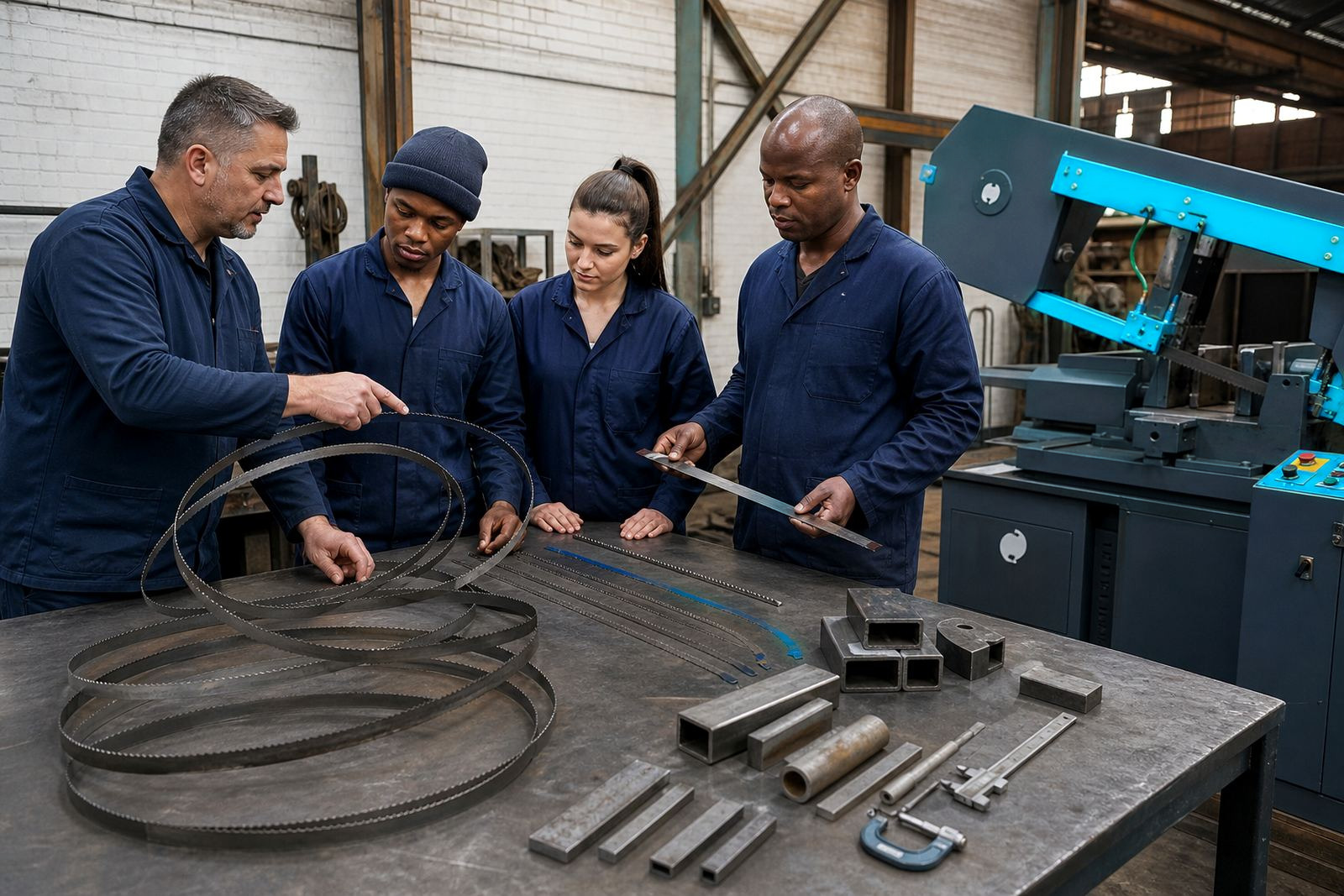
Blade work that starts with the material and the machine
MoreCut Saws grew around a straightforward trade problem: a blade only earns its place when it suits the machine, the stock size and the cut you actually need. A blade for mild steel bar behaves differently from one used on thick wall tube, stainless sections or bundled stock, and the wrong match shows up fast in teeth stripping, wandering cuts or a finish that asks for too much clean-up. The shop in Alrode keeps the focus on that practical fit. We work with bandsaw blades and hacksaw blades in carbon steel and bi-metal forms, including fine and coarse tooth counts, variable pitch layouts and widths that suit light manual saw work or heavier frame machines.
Match the blade geometry to the job, then keep the cut stable with the right feed, speed, coolant and run-in. That is how the team talks through a job, whether the request is for a short blade, a welded blade to length, or a starter kit for a workshop setting up a new saw line.
The Alrode base and the people behind the counters
The base in Alrode, Alberton gives the team room to handle orders, blade welding and the day-to-day stock checks that keep a blade shop's records right. Sibusiso Dawood leads the business as Managing Director, with Anika Nortje handling sales, Pieter Moonsamy working on blade welding, Lerato Zungu covering technical support, Themba Chetty coordinating operations and Chanel Jacobs helping customers with the practical side of each order. Each person has a narrow part to play, but the customer feels one joined-up service rather than separate counters passing a note around.
A workshop may need a blade cut to a specified length, or a machine fit check may show a different width or tooth pitch from the one first requested. The conversation stays close to the job, the machine and the material. There is no need for grand talk, just enough detail to keep the saw running properly.
- Blade welding for bandsaw loops cut to the required length
- Length verification before a blade is fitted or sent out
- Machine fit checks for frame clearance and wheel size
- Guidance on tooth pitch, blade width and thickness
How we handle selection without making it complicated
Blade selection usually comes down to a few measurements and a few honest details about the work. What material is being cut, what section size is most common, how smooth the finish needs to be, and whether the machine runs on a manual or powered feed. From there the team can look at tooth pitch in TPI, variable pitch for mixed bundles, blade width for stability and blade thickness for stiffness. A narrow blade can suit tighter radii and smaller machines, while a wider blade gives better tracking on heavier work. Tooth set and gullets need checking, especially where chips need to clear cleanly.
Feed speed and coolant checks sit in the same discussion because a blade that is technically correct can still fail early if the cut is too aggressive or the blade runs dry on material that needs cooling. Run-in guidance is part of the handover too. A fresh blade needs a lighter first period so the teeth settle in without shock loading on the first cut. That sort of practical guidance is where the team spends time, because small adjustments make a noticeable difference in blade life and cut quality.
- Bi-metal M42 style blades for tougher metal cutting duties
- Carbon steel blades for lighter work and manual saw use
- Variable pitch options for mixed section sizes
- Run-in guidance for new blades before full production use
Starter kits for workshops setting a cleaner baseline
Some customers need more than one blade. They need a starting point that can cover a few common jobs without turning stock control into a mess. That is where starter kits and stock standardisation fit in. MoreCut Saws can help a workshop narrow down the widths, pitches and lengths that match the machines already on site, so the blade cupboard holds sensible options rather than a pile of near-misses. For smaller teams, that also makes manual saw support easier because the right blade is there when a hand-fed cut comes up.
Starter kit planning usually covers the types of material cut most often, the frame sizes in use, and whether the site prefers a lean stock range or a broader spread of blades for different sections. Starter kit planning cuts wrong fits and wasted blades, and gives reordering a cleaner pattern. It is steady work, but it saves time in the middle of a busy shift.
South African deliveries with local sense
From Alrode, Alberton, MoreCut Saws supplies workshops across Johannesburg, Pretoria, Vereeniging, Durban and Cape Town, with branch coverage that also reaches Germiston and Boksburg. Metalwork sites across South Africa use different materials and saws, so we plan the right spread for each job. A fabrication shop near the Reef may cut mild steel sections all day, while a coastal workshop in Durban needs to think harder about storage, corrosion and coolant condition in humid air. Cape Town sites often want the same practical blade advice, but for different mixes of material and machine age.
Whether the order is for an individual blade, a welded loop, or a set of blades aimed at standardising a workshop stock, the service stays close to the real conditions in the shop. Send the blade dimensions, material, saw type and any issues with tooth breakage or wandering cuts. That keeps the next step specific instead of vague.
- Alberton Supply and Germiston Supply for local workshop support
- Johannesburg Supply and Boksburg Supply for metro trade needs
- Pretoria Supply for fabrication and maintenance sites
- Vereeniging Supply, Durban Supply and Cape Town Supply for wider regional coverage
What the team looks at when a blade keeps failing
Blade failure review uses the cut marks, the tooth wear, the break point and the machine settings in use at the time. A blade that snaps at the weld needs a different conversation from one that strips teeth across the full length. Look at feed pressure, blade speed, blade tracking, gullets packed with swarf and coolant delivery. The machine’s own condition is important too. A guide wheel out of line can make a good blade look wrong, and an oversized pitch can punish a small saw.
That is why the business keeps the work hands-on. The people here are dealing with the same sorts of failures that happen in ordinary workshops, where a machine must cut accurately and keep moving. The service is built around getting the right match between blade, machine and material for the job.